- Project Biohacking Newsletter
- Posts
- Mitochondria on Demand: The Peptide That Teaches Tired Cells How to Make More Energy
Mitochondria on Demand: The Peptide That Teaches Tired Cells How to Make More Energy
When energy production becomes the problem, SS-31 bypasses the bottleneck

Jeffrey Nunn
February 04, 2026
Hey Biohackers,
Your body runs on ATP. Every thought, movement, and heartbeat depends on mitochondria producing it efficiently. But mitochondria don't stay efficient forever.
Aging, oxidative stress, and metabolic dysfunction damage the inner mitochondrial membrane—the exact site where ATP gets made. When that membrane degrades, energy production drops. Cells slow down. Systems falter.
That's where SS-31 comes in.
Unlike broad antioxidants or generic "mitochondrial support," SS-31 targets a single, critical molecule inside the mitochondrial membrane: cardiolipin. And when cardiolipin is stabilized, energy production improves at the source.
Affiliate Disclosure: This newsletter contains affiliate links. When you purchase through these links using code PROBIO15, I may earn a commission at no additional cost to you. I only recommend vendors I personally use and trust.
What SS-31 Actually Does
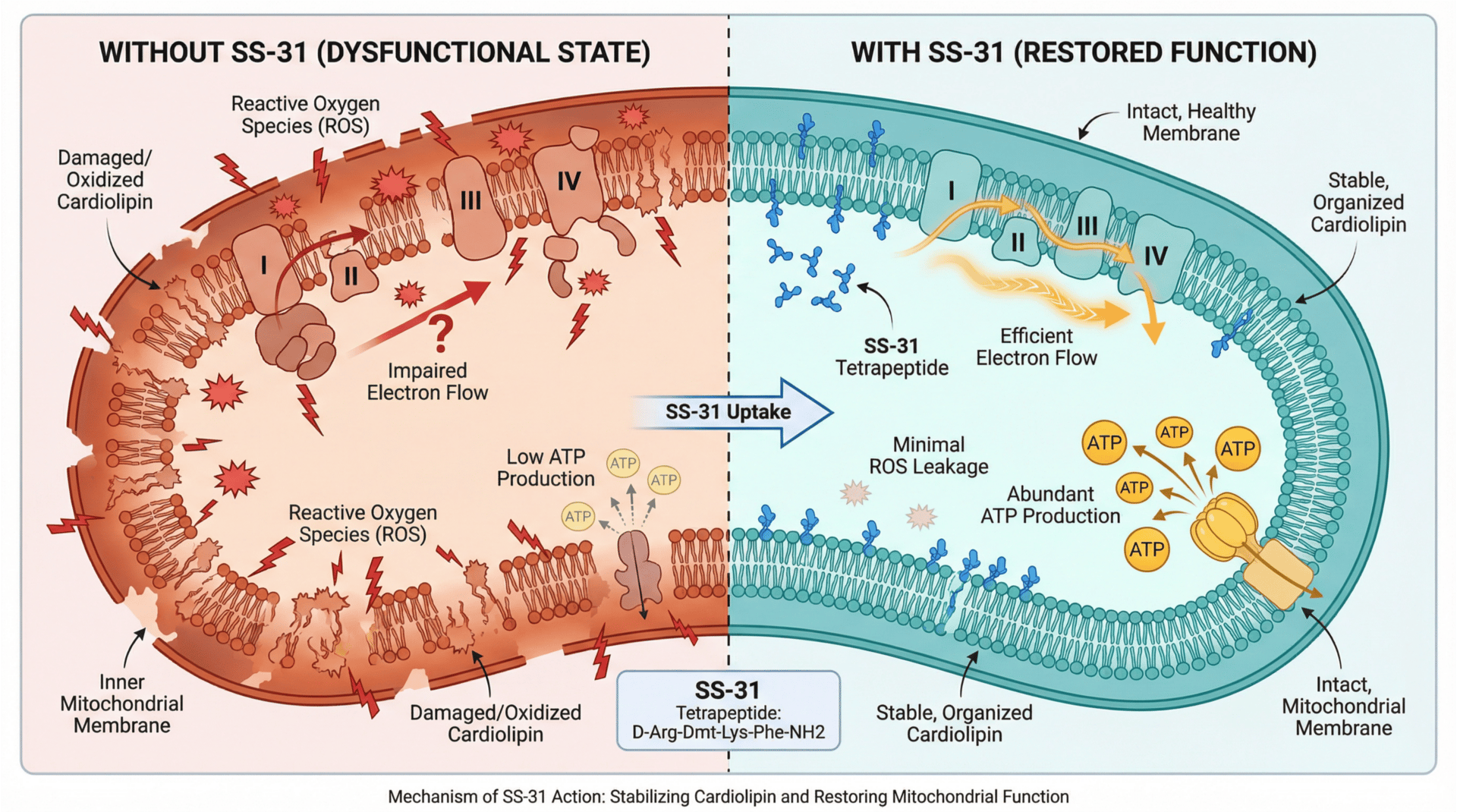
SS-31 is a mitochondria-targeted tetrapeptide. It crosses cell membranes, enters mitochondria, and binds directly to cardiolipin—a phospholipid embedded in the inner mitochondrial membrane.
Cardiolipin holds the electron transport chain in the right configuration. When it's oxidized or degraded, ATP production becomes inefficient. Reactive oxygen species leak. The mitochondria themselves begin to dysfunction.
SS-31 prevents that breakdown by:
Stabilizing cardiolipin structure so the electron transport chain operates cleanly
Reducing electron leakage that creates harmful reactive oxygen species
Improving ATP synthesis efficiency without increasing oxidative damage
Supporting membrane integrity in aging or stressed mitochondria
This isn't about flooding the system with antioxidants. It's about fixing the machinery at the point of failure.
Why Mitochondrial Precision Matters
Most interventions aimed at energy production work indirectly. They support substrate availability, reduce inflammation, or scavenge oxidative byproducts after the fact.
SS-31 works inside the mitochondria, at the membrane where energy production happens. That precision changes the risk-to-benefit calculation.
Because it targets a structural molecule rather than a signaling pathway, SS-31 doesn't trigger compensatory downregulation. It doesn't suppress natural mitochondrial biogenesis. It doesn't interfere with hormonal or metabolic feedback loops.
It just makes damaged mitochondria work better.
Who Considers SS-31?
SS-31 shows up in conversations around:
Fatigue-dominant conditions where mitochondrial dysfunction is suspected
Age-related decline in cellular energy production
Recovery from metabolic stress or ischemic events
Neurological conditions where neurons struggle with energy demand
Performance contexts where mitochondrial efficiency becomes a bottleneck
It's not a first-line intervention. It's a precision tool for specific failure modes.
The Cardiolipin Hypothesis
Cardiolipin isn't just another membrane lipid. It's mitochondria-specific, and it only exists in the inner membrane—the exact location where ATP synthesis happens.
When cardiolipin oxidizes:
Cytochrome c (part of the electron transport chain) detaches
Electron flow becomes inefficient
ATP output drops while oxidative stress increases
The mitochondria signal for degradation (mitophagy)
SS-31 prevents that cascade. By stabilizing cardiolipin, it keeps the electron transport chain intact, reduces ROS production, and maintains ATP output—even in mitochondria that are structurally compromised.
This is why SS-31 works in contexts where general antioxidants don't. It's not scavenging free radicals after they've been created. It's preventing their formation at the source.
What SS-31 Doesn't Do
SS-31 doesn't increase mitochondrial number. It doesn't trigger biogenesis pathways or upregulate PGC-1α.
It doesn't modulate hormones, inflammation, or immune function directly.
It doesn't fix substrate-level problems. If ATP production is limited by lack of oxygen, nutrients, or cofactors, SS-31 won't bypass those constraints.
What it does do is restore efficiency in mitochondria that are structurally intact but functionally impaired. It's a repair tool, not a growth signal.
The Efficiency Question
Mitochondrial efficiency isn't just about making more ATP. It's about making ATP cleanly—with minimal oxidative byproducts and maximum coupling between oxygen consumption and energy output.
SS-31 improves that ratio. Studies in animal models show increased ATP/O₂ ratios, reduced lipid peroxidation, and improved performance in tissues under metabolic stress.
In human contexts, that translates to better energy availability in cells that were previously struggling—without creating new oxidative debt.
Limitations and Context
SS-31 doesn't work in isolation. Mitochondrial health depends on substrate availability, cofactor support, and systemic metabolic context.
If a person is deficient in CoQ10, magnesium, or B vitamins, SS-31 won't compensate. If their diet creates chronic oxidative stress or insulin resistance, the benefits may be limited.
And because SS-31 is highly specific, it won't address problems that originate outside the mitochondria. It won't fix gut dysfunction, hormone imbalances, or inflammatory drivers unless those problems stem from mitochondrial failure.
Context matters.
Why Mitochondria Matter for Longevity
Aging is, in many ways, mitochondrial decline. As mitochondria lose efficiency, cells produce less ATP, generate more oxidative stress, and trigger senescence pathways.
SS-31 addresses that decline at the membrane level. It doesn't reverse aging, but it delays the functional consequences of mitochondrial degradation.
That delay matters. In organs with high energy demands—heart, brain, skeletal muscle—mitochondrial efficiency is often the limiting factor in health-span.
Where to Source SS-31
If you're considering SS-31, sourcing matters. Mitochondrial-targeted peptides require precision synthesis and third-party verification.
Biolongevity Labs offers SS-31 with independent testing for purity and molecular integrity. They specialize in peptides where structure determines function—exactly the context where quality control is non-negotiable.Coaching Packages Updated
Project Biohacking Resources
Some links may be affiliate links; I may earn a small commission at no extra cost to you. I only recommend vendors I use Biolongevity Labs.

👇🏻Oral Bioregulators Discount Codes | PROBIO10 for 10% off👇🏻
👇🏻Supplements Affiliates👇🏻
👇🏻Lab Affiliatess👇🏻
Guides

🔚 Outro & Final Thoughts
SS-31 isn't a universal energy fix. It's a precision intervention for a specific problem: damaged or inefficient mitochondrial membranes.
When the limitation is structural—when cardiolipin is oxidized and the electron transport chain is leaking—SS-31 restores function at the source.
That's not magic. It's molecular precision applied to cellular energy production.
And in contexts where mitochondrial efficiency is the bottleneck, precision matters.
Until next time, stay ahead of your age!
– Jeff
Founder, Project Biohacking
Affiliate & Earnings Disclosure
Project Biohacking participates in affiliate partnerships with select peptide vendors. When you make purchases through the links provided in this newsletter or use discount code PROBIO15, I may receive a commission at no extra cost to you.
These affiliate relationships do not influence my recommendations, I only promote products and vendors I personally use, have researched thoroughly, and believe provide value to the biohacking community. All opinions expressed are my own based on personal experience and research.
Your support through these affiliate links helps fund the research, testing, and content creation that makes Project Biohacking possible.
Disclaimer: I’m here to share what I’ve learned, not to replace your doctor. Always check with a qualified healthcare provider before trying anything new. And yes, peptides are often for research use only; please don’t turn your kitchen into a chemistry lab without supervision.